How Road Salt Damages Your Vehicle
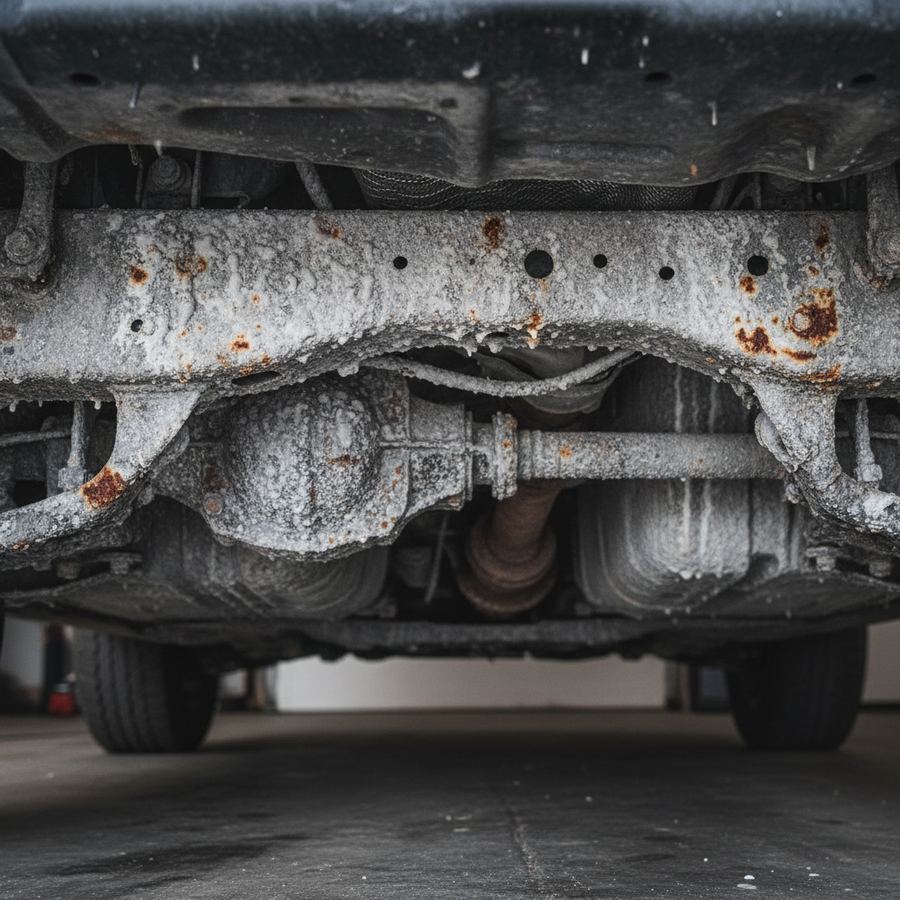
Road salt keeps highways safe. It also destroys vehicles. Those two facts coexist, and in Ontario where millions of tonnes of sodium chloride get spread on roads every winter, the second fact costs vehicle owners billions of dollars collectively in premature repairs, failed inspections, and scrapped vehicles.
Most people know salt causes rust. Fewer people understand the mechanism, and that matters because understanding how salt damages your vehicle changes what you do about it.
Salt Does Not Cause Rust by Itself
Rust is iron oxide. It forms when iron or steel is exposed to oxygen and water. That process happens without any salt at all, just slowly. A car in a dry climate will eventually develop surface rust on bare metal, but it might take decades to become a problem.
Salt accelerates the process by acting as an electrolyte. When sodium chloride dissolves in water, it creates a solution that conducts electricity much more efficiently than plain water. This speeds up the electrochemical reaction that converts iron into iron oxide. The corrosion rate in salt water can be 5 to 10 times faster than in fresh water.
That is why a vehicle in coastal British Columbia rusts differently than one in northern Ontario. The BC vehicle deals with moisture. The Ontario vehicle deals with moisture and a concentrated electrolyte solution sprayed directly onto its underside for 5 months of the year. The rate of destruction is in a completely different category.
Where the Damage Happens
Salt does not damage your vehicle evenly. It concentrates in specific areas based on how road spray reaches the underside and where moisture gets trapped. Understanding these zones helps you know what to inspect and what to protect.
Brake Lines
Steel brake lines run along the underside of the vehicle, clipped to the frame or body. They are exposed to direct salt spray from the wheels. Over time, salt corrosion pits the outer wall of the line. The line does not fail all at once. It thins gradually until one hard brake application pushes fluid through the weakened wall.
A brake line failure is a safety emergency. You press the pedal and it goes to the floor. On a dual-circuit system, you still have braking on one axle, but stopping distances increase dramatically. On older vehicles where both circuits have corroded lines, total brake failure is possible. This is not theoretical. It happens every year in Ontario and is one of the most common reasons vehicles fail safety inspections.
Fuel Lines
Fuel lines follow similar routing to brake lines and face the same exposure. Corroded fuel lines leak gasoline or diesel, which is a fire hazard. Modern vehicles use more corrosion-resistant materials for fuel lines than older ones, but the connections, brackets, and fittings are still vulnerable. A fuel leak under a hot exhaust component is as dangerous as it sounds.
Subframe and Frame Rails
The subframe carries the engine, transmission, and front suspension. Frame rails support the body and rear suspension. These are structural components. When they corrode, the vehicle is compromised in ways that cannot be fixed economically.
Salt collects on the top surfaces of the subframe where road spray splashes up and sits. Water pools in crevices and low spots. Freeze-thaw cycles crack any existing protective coating, letting moisture reach bare steel. Over 10 to 15 winters, a subframe can go from solid to structurally unsound. The NHTSA recall database includes multiple cases of subframe corrosion recalls on vehicles sold in salt-belt states and provinces.
Rocker Panels and Wheel Wells
Rocker panels sit between the front and rear wheels at the bottom of the door openings. They take constant salt spray from both tire sets. The outer skin rusts visibly, but the real damage is inside. Rocker panels are enclosed box sections. Moisture and salt get inside through seams and drain holes, and if those drain holes clog with road debris, the panel fills with salt water that has nowhere to go. It corrodes from the inside out. By the time you see bubbling paint on the outside, the inside is already gone.
Wheel wells catch the full blast of spray from the tires. The plastic inner fender liners help, but they trap debris behind them. Salt and grit pack between the liner and the metal fender, holding moisture against the paint. Pull the liner back on a 5-year-old Ontario vehicle and you will often find corrosion already starting on the fender metal underneath.
Door Bottoms and Tailgate
Doors have drain holes at the bottom to let condensation escape. When those holes clog, water sits inside the door skin and rusts it from within. The bottom edge of the door is where you first see bubbling paint, but the structural inner panel has usually been deteriorating for years by that point. The same process affects tailgates on trucks and SUVs. Knowing where to look for early corrosion makes all the difference in catching this before it spreads.
Why Washing Helps but Is Not Enough
A lot of advice boils down to "wash your car regularly in winter." That is good advice as far as it goes. Washing removes salt from surfaces before it has time to do maximum damage. A good undercarriage wash at a car wash or self-serve bay flushes salt off the underbody, frame, and suspension components.
The problem is that washing cannot reach the areas where the worst damage happens. It cannot get inside rocker panels. It cannot penetrate the crevices in a subframe. It cannot flush salt out of spot-welded seams or enclosed body cavities. These are the areas where salt water sits for months, doing slow, invisible damage that you do not discover until the metal is already compromised.
Washing also does nothing to protect bare metal. Once a stone chip, a scratch, or a worn coating has exposed steel, every salt contact accelerates corrosion at that point. Washing removes the salt temporarily, but the next drive puts it right back.
Going Beyond the Car Wash
An annual underbody protection service addresses the areas a car wash cannot reach. Oil-based rust proofing penetrates into seams, cavities, and enclosed spaces where salt water collects. Applied before winter, it creates a barrier between the salt solution and bare metal in the places most vulnerable to corrosion. Combined with regular washing during salt season, it covers both the accessible and inaccessible areas of the vehicle.
The Compounding Effect
Salt damage is cumulative. Each winter adds to the corrosion from the previous one. A vehicle that has survived 5 Ontario winters without protection has 5 years of accumulated damage that cannot be undone. The sixth winter does not start from zero. It starts from wherever the fifth winter left off.
This is why vehicles in salt-belt climates deteriorate on an exponential curve rather than a linear one. The first few years show minor surface rust. Then the rate increases as protective coatings fail, more bare metal gets exposed, and corrosion products create crevices that trap more moisture. By year 10 or 12, the damage accelerates rapidly. What looked like manageable surface rust at year 7 has become structural compromise by year 12.
Starting protection early flattens that curve. A vehicle that has been rust proofed annually from new looks dramatically different underneath at year 10 than one that was not. The difference is often the difference between a vehicle worth keeping and one headed for the scrapyard.
What You Can Do
Preventing salt damage is a combination of habits and treatments:
- Wash the undercarriage regularly during winter. Every 2 weeks during active salt season is a reasonable frequency. Focus on the underbody, not just the paint.
- Get the underbody washed thoroughly after the last salt event of the season. Do not let salt sit through spring and summer.
- Apply rust proofing before winter each year. Oil-based products that penetrate enclosed cavities provide the protection washing cannot.
- Touch up paint chips promptly. A $10 touch-up pen on a stone chip prevents a $500 rust repair later.
- Inspect the underbody annually. Look at brake lines, fuel lines, subframe, and rocker panels. Catching problems early is always cheaper than catching them late.
Salt is an unavoidable part of driving in Ontario. The damage it causes is not. Consistent prevention costs a fraction of the repairs it avoids, and it keeps your vehicle's long-term reliability intact. The vehicles that last 15 or 20 years in this climate are not lucky. They are protected. The ones that rot out at 10 years are not unlucky. They just never got the attention they needed underneath.