Repairs Not Worth Doing: When to Walk Away From Your Car
There is a line between keeping a car alive and refusing to let it die. Most repairs on an older vehicle are worth doing. Some are not. The ones that are not share a common feature: the cost of the repair approaches or exceeds the value it creates, and the underlying condition of the vehicle means more expensive failures are coming regardless.
Knowing when to walk away is just as important as knowing when to fix. Here are the repairs where the math stops working.
Rusted Subframes and Frame Rails
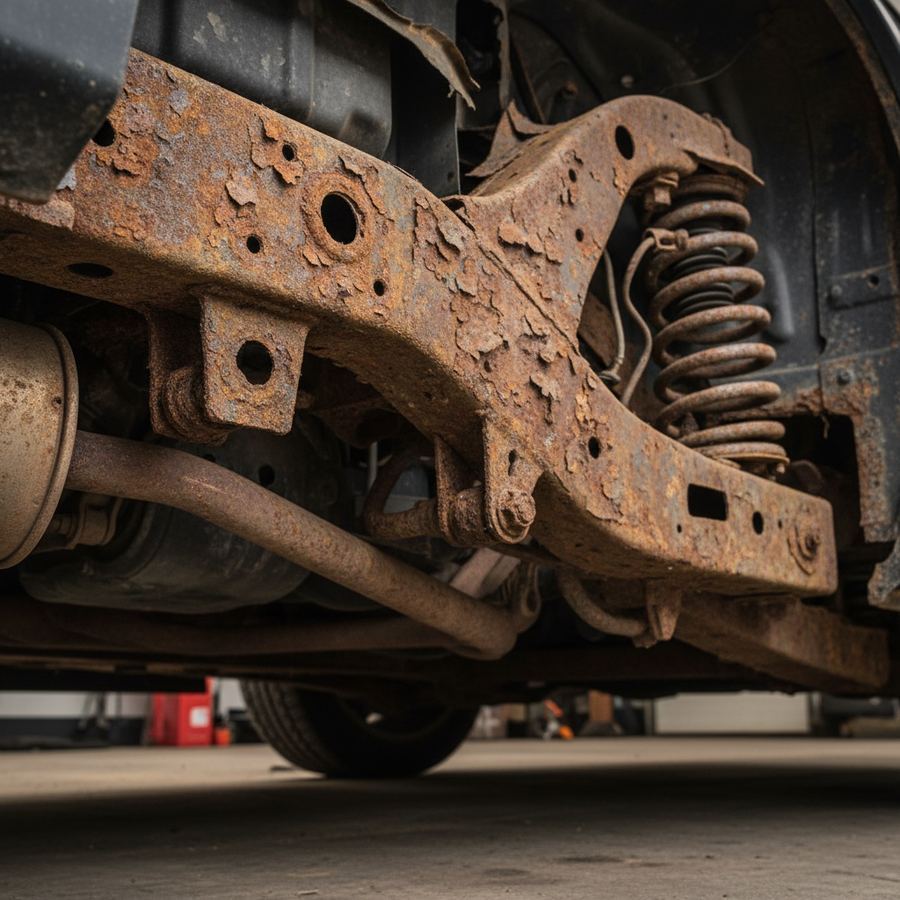
This is the number one reason to stop putting money into a vehicle. When structural rust reaches the subframe, frame rails, or floor pans, the car is fundamentally compromised. No mechanical repair changes the fact that the structure holding everything together is failing.
Subframe rust is common in salt-belt climates. Over 12 to 15 years of salt exposure, even well-maintained vehicles develop serious corrosion. A subframe replacement can cost $2,000 to $4,000, but if the subframe is rusted, the brake lines, fuel lines, suspension mounting points, and body mounts are all corroding at the same rate. Replacing the subframe just buys time before the next structural failure.
Once structural rust is severe enough to affect safety, the car is done even if the engine runs perfectly.
Blown Head Gaskets on High-Mileage Engines
A head gasket failure at 60,000 miles is a clear fix. Spend the $1,500 to $2,500 and move on. At 200,000 miles, the situation is different. The engine has 200,000 miles of wear on bearings, rings, and valve guides. Fixing the head gasket does not address any of that. You are spending $2,000 on an engine near the end of its service life.
The risk is that you fix the gasket and three months later the engine burns oil or develops a rod knock. There is also the question of why it failed. On a high-mileage engine, warpage from overheating means the head needs resurfacing or replacement, adding cost. If the block is warped too, you are looking at an engine replacement, not just a gasket job.
The exception is engines known for head gasket issues at any mileage, like certain Subaru EJ motors. That is a design weakness, not a sign of overall wear. If the rest of the engine is solid and the vehicle is in good shape, the repair can still make sense.
Full Transmission Rebuilds on Economy Cars
A transmission rebuild runs $2,500 to $4,500 on most vehicles. On a mid-size truck or a vehicle worth $15,000, that can be a reasonable repair. On a 12-year-old Civic, Corolla, or Sentra worth $3,000 to $5,000, you are spending half the car's value on one component.
The math gets worse when you consider that economy cars in this age and price range often have other issues too. The suspension has 150,000 miles on it. The engine is aging. The interior is worn. You are rebuilding the transmission in a vehicle that will continue to need money in other areas.
A used transmission from a salvage yard is a less expensive option at $800 to $1,500 installed, but used transmissions are a gamble. You do not know how it was driven or maintained. Warranty coverage on used transmissions is often limited to 30 to 90 days. If the used unit fails, you are back where you started.
For economy cars with transmission failure, the honest answer is often that the replacement calculation has shifted. The repair no longer buys enough reliable life to justify the cost. Sell the car for what it is worth as a mechanical project or parts car, and put the repair money toward something else.
Engine Replacement on Vehicles With Other Problems
An engine swap or rebuild costs $3,000 to $7,000 depending on the vehicle. That is a lot of money, and it only makes sense if the rest of the vehicle is worth putting an engine into.
If the body is solid, the transmission shifts well, the suspension is in good shape, and the interior is acceptable, an engine replacement can give you a practically new vehicle for a fraction of replacement cost. This is especially true on trucks and larger vehicles where a comparable replacement would cost $15,000 or more.
But if the engine failure is just the latest in a series of problems, the engine swap does not change the trajectory. You will have a new engine in a vehicle that still needs ball joints, wheel bearings, a leaking power steering rack, and a transmission that slips. The engine was the headline expense, but the supporting cast of repairs is what makes this a bad investment.
Extensive Electrical Repairs on Older Vehicles
Electrical problems on vehicles over 15 years old can be a bottomless pit. Wiring harnesses degrade, connectors corrode, and modules fail. A single electrical issue with a clear diagnosis is fixable. A vehicle with multiple intermittent faults where the shop has spent 4 hours diagnosing and still is not confident is a money trap. You can spend $1,000 in diagnostic time alone with no guarantee the fix is complete.
European luxury vehicles from the mid-2000s are particularly prone to this. Complex electronics and age-related wiring degradation create diagnostic nightmares. A $5,000 BMW with $3,000 in electrical gremlins is a car to walk away from.
Catalytic Converter Replacement on End-of-Life Vehicles
OEM catalytic converters run $1,000 to $2,500 installed, and some vehicles need multiple. On a vehicle you plan to keep, replacement is worthwhile. On a vehicle approaching end of life from other factors, spending $1,500 to pass emissions on a car you will likely scrap in 12 months is poor math. Weigh the converter cost against the cost of replacing the vehicle, and be realistic about how much longer the car will last even with the new converter.
How to Know When You Have Crossed the Line
There is no single dollar amount that separates a worthwhile repair from a bad one. It depends on the vehicle's overall condition, its market value, and what replacement would cost. But here are the warning signs that you are past the point of diminishing returns:
- The repair list keeps growing. What started as one item turns into three. Each time you fix something, another problem surfaces. The car is aging out of reliability across all systems.
- Structural issues exist. Rust in structural areas means a hard ceiling on the vehicle's remaining life regardless of how much you spend mechanically.
- You are repairing the same systems repeatedly. A second alternator in two years might just be bad luck. A second transmission issue in two years is a pattern.
- The cumulative annual repair cost exceeds a car payment. If you are spending $400 or more per month on average to keep the car running, that money goes further toward something newer and more reliable.
- Safety is a concern. If you are not confident the car will get you home safely, no amount of budget math matters.
Walking away from a car you have invested in is not easy. But holding onto it past the point where the numbers work is how people end up spending $6,000 over two years on a car they eventually scrap anyway. Recognizing the repairs that make sense, doing those, and drawing the line when the vehicle's condition no longer supports further investment is the most practical approach. Spend your repair budget on a car that will actually use it, not one that has already used it all up.
If you are not sure where your car falls, an honest inspection from an independent shop is the best $100 you can spend. Have them look at everything, not just the current complaint. A full digital inspection with photos gives you the complete picture so you can make the call with real information instead of a gut feeling. And if the answer is that it is time to move on and avoid another money pit, that is a valuable answer too.