Repair Budgeting Basics: How to Plan for Vehicle Repairs
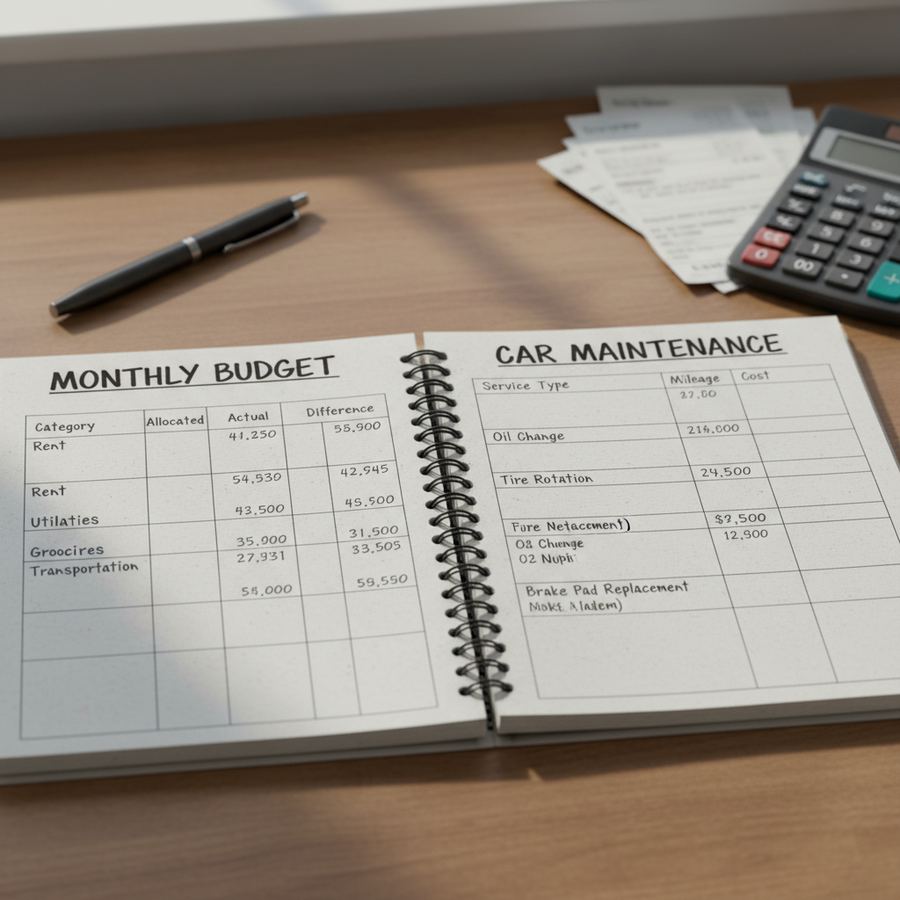
Most people treat car repairs like natural disasters: unpredictable, unavoidable, and financially devastating. But car repairs aren't unpredictable. Most follow patterns. Brakes wear based on driving style and mileage. Batteries die based on age and climate. Tires need replacing on a roughly calculable schedule. The "surprise" repair bill is usually only a surprise because nobody bothered to see it coming.
Budgeting for repairs means accepting that your car will need money spent on it and setting that money aside before the need arrives.
The Emergency Repair Fund
Before anything else, build a buffer. A dedicated savings cushion for vehicle repairs, separate from your general emergency fund. Target $1,500 to $3,000 depending on your vehicle's age.
Under five years old and reliable? $1,500 is a reasonable start. Most repairs on newer vehicles cost under a thousand for common issues. Over eight years old or past 150,000 km? Aim for $2,500 to $3,000. At that age, you're looking at timing belts, water pumps, catalytic converters, and AC compressors. Any one of those runs $800 to $2,000.
Build it by setting aside $100 to $200 monthly. If that sounds like a lot, compare it to a $400-$600 monthly car payment on a new vehicle. Setting aside $150 for a paid-off car's repairs is one of the cheapest ways to stay mobile.
Seasonal Expenses You Can Predict
Some costs are tied to the calendar. You know they're coming.
Tires. If you run winter and summer sets, that's two changeover costs per year ($60 to $120 each) plus eventual replacement ($400 to $800 per set). If your current tires have two seasons left, start saving now. If your shop offers seasonal tire storage, services like TireCloud help them track your stored sets. That's one less thing to manage, and it means your tires aren't deteriorating in a hot shed.
Battery. Batteries last three to five years. In extreme climates, lean toward three. If yours is approaching its third winter, budget $150 to $250 for a replacement. Having it tested before cold season costs nothing at most shops.
Wipers and fluids. Minor but they add up. Budget $50 yearly for new wipers and washer fluid before the wet season.
Predictable Failures by Mileage
Certain components have roughly predictable lifespans. If you know your annual mileage, you can map these on a timeline.
Brakes (40,000 to 80,000 km). City driving wears pads in 40,000 km. Highway driving stretches them to 80,000+. Budget $300 to $600 per axle for pads and rotors.
Timing belt (90,000 to 160,000 km). Not all vehicles have one, but if yours does, this costs $600 to $1,200 and should never be skipped. A failed belt on an interference engine destroys the engine.
Suspension (100,000 to 180,000 km). Struts, ball joints, tie rods, bushings. A full refresh on one axle runs $800 to $1,500. Doing front one year and rear the next spreads the cost.
Water pump (100,000 to 200,000 km). Often replaced with the timing belt since labor overlaps. Standalone, $300 to $700.
AC compressor (150,000+ km). No way to predict precisely. Typically $800 to $1,500, and it tends to fail during the season you need it most.
Tracking Your Spending
Keep a simple record of every repair expense. Spreadsheet, phone note, folder of receipts. The format doesn't matter. What matters is looking back over twelve months and seeing exactly what you spent.
This shows whether your monthly budget is accurate and helps spot trends. If your older vehicle needed $1,200 last year and $2,800 this year, the trajectory is telling you whether continued investment makes sense.
Tracking also makes conversations with your mechanic productive. "I spent $2,400 last year. What's likely coming?" A good mechanic can give you a realistic forecast based on your vehicle's condition. That forecast becomes next year's budget.
The Annual Budget Framework
Newer vehicle (under 5 years, under 80,000 km): $1,200 to $1,800 per year. Routine maintenance, one or two minor repairs, tire replacement every few years.
Mid-age vehicle (5-10 years, 80,000 to 200,000 km): $1,800 to $3,000 per year. Bigger items start appearing: brakes, suspension, belts, hoses. Seasonal maintenance matters more as parts age.
Older vehicle (10+ years, 200,000+ km): $2,500 to $4,000 per year. You're managing a vehicle through its later life. The math works if the car is reliable between repairs, but you need a bigger buffer.
These are averages for typical reliable vehicles. If you're driving something known for expensive failures, adjust upward.
When the Budget Says Move On
Your repair budget eventually tells you when to stop. When annual costs consistently exceed what a replacement would cost to own (including its own repairs), the math favors moving on.
If your paid-off car costs $3,500 a year in repairs, that's still less than a $400 monthly payment plus insurance increases. But $5,000 a year with accelerating problems? A replacement starts making sense. The repair fund you've been building makes that transition easier. Two years of saving $150 monthly on a reliable car leaves you $3,600 toward the next one.
Budgeting for repairs isn't exciting. It's one of those responsible things that feels pointless until your mechanic calls with a $1,400 estimate and you can say "go ahead" without your stomach dropping. That calm is worth every monthly transfer. Start now.