When to Replace Your Tires: Tread, Age, and Damage
Tires don't come with a warning light. They wear gradually, age quietly, and most people don't think about them until something goes wrong. But tires are the only contact between your vehicle and the road. Every safety system on your car, from ABS to stability control, depends on the tires having enough grip to do their job. Knowing when to replace them is one of the most practical safety decisions you can make.
Tread Depth: The Numbers That Matter
New tires typically start with 10/32" to 12/32" of tread depth. As you drive, that tread wears down. The question is: how low is too low?
The legal minimum in most Canadian provinces and US states is 2/32" (1.6 mm). At that depth, the tire is legally worn out. But legal and safe are not the same thing. By the time a tire reaches 2/32", it has already lost most of its ability to channel water, which means hydroplaning risk in rain is severe. Snow traction at 2/32" is essentially zero.
The practical replacement point is 4/32" for most driving. At that depth, the tire still has some wet traction but it's diminishing noticeably. If you drive through Ontario winters, most tire experts recommend replacing at 5/32" or even 6/32" because snow traction drops off steeply once you get below that range.
Think of it this way: the first 50 percent of tread wears slowly and the tire performs well. The last 25 percent is where performance drops rapidly. Waiting until the legal limit means you've been driving on compromised rubber for thousands of kilometres before replacement.
The Penny Test and Why It Has Limits
The penny test is simple. Insert a Canadian penny into the tread groove with the Queen's crown pointing down. If you can see the entire crown, the tread is at or below 2/32" and the tire is legally done.
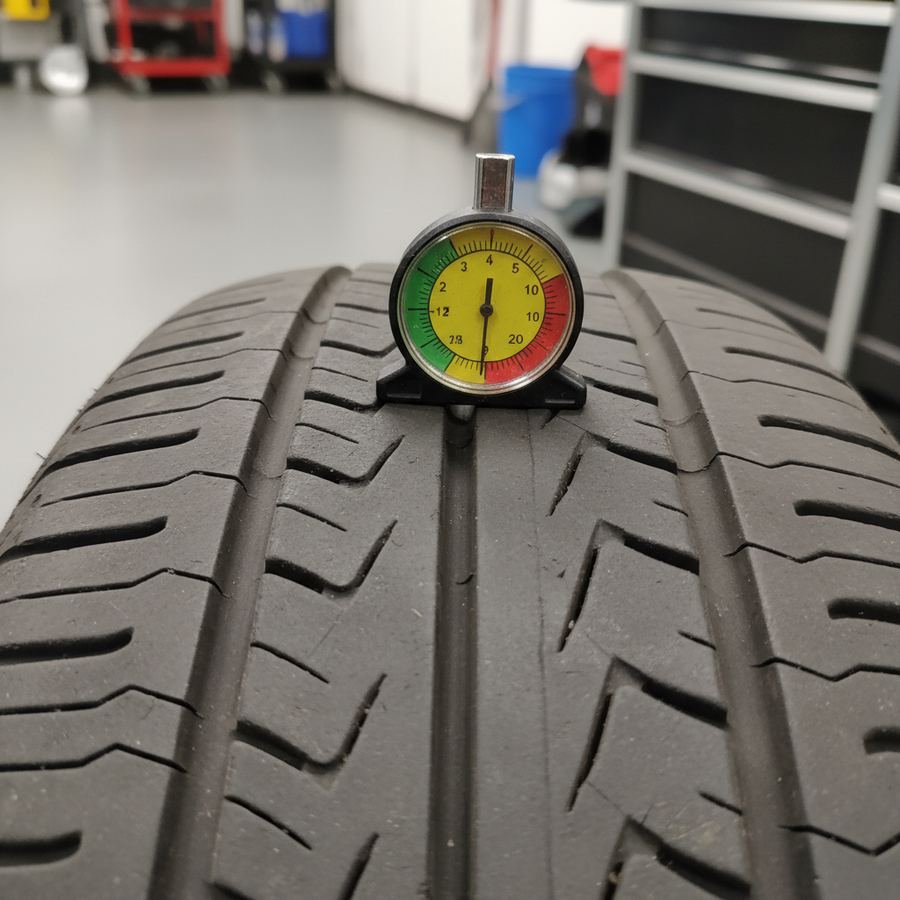
The problem with the penny test is that it only tells you whether you've passed the legal minimum. It doesn't tell you whether you're at 4/32" or 3/32", which is the range where you should actually be planning replacements. A tread depth gauge costs $5 at any auto parts store and gives you an actual measurement. Use the gauge in multiple spots across the face of the tire and in multiple grooves. This takes 30 seconds per tire and gives you real data instead of a pass/fail.
Measure tread depth at the outer edge, the centre, and the inner edge of each tire. If the numbers are different at each location, you have uneven wear, which tells you something important about your vehicle beyond just the tires themselves.
What Uneven Wear Is Telling You
Tread should wear evenly across the face of the tire. When it doesn't, the wear pattern is diagnostic.
Both edges worn, centre full: The tire has been running underinflated. Low pressure causes the sidewalls to flex more, loading the edges. This is the most common wear pattern and usually means the driver hasn't been checking pressures regularly.
Centre worn, edges full: Overinflation. Too much air pressure causes the centre of the tread to carry most of the load. Less common but still happens, especially when people inflate to the number on the tire sidewall instead of the number on the door jamb sticker.
One edge worn: Alignment is off. A vehicle pulling to one side or with incorrect camber or toe angles will scrub one edge of the tire. This wears through tires fast. If you see one-edge wear, replacing the tires without fixing the alignment just means the new set will wear the same way.
Patchy or cupped wear: Usually indicates worn shocks or struts, unbalanced tires, or both. The tire is bouncing slightly as it rolls, creating uneven contact patches. This produces a distinctive scalloped pattern you can feel by running your hand across the tread.
Uneven wear turns tire replacement from a simple purchase into a maintenance decision. Fix the underlying problem first, then put new rubber on. Otherwise you're just feeding new tires into the same meat grinder.
Tire Age: The Clock That's Always Running
Rubber degrades over time whether the tire is being used or not. Heat, UV exposure, and oxygen slowly break down the compounds that provide flexibility and grip. A tire that has been sitting in a garage for six years with perfect tread depth has still lost meaningful performance.
Most tire manufacturers recommend replacement at six years from the date of manufacture, and ten years as the absolute maximum regardless of appearance. Vehicle manufacturers including Ford and Mercedes-Benz specify six years in their owner's manuals.
You can check the manufacture date using the DOT code on the sidewall. The last four digits indicate the week and year. A code ending in 2024 means the tire was made in the 20th week of 2024. For the full breakdown of how to read these codes and what condition signs to look for, our tire age and condition guide goes into detail.
Age matters especially for spare tires. Most people never check their spare. It sits in the trunk or under the vehicle for a decade, and when they finally need it, the rubber is cracked and the air is gone. Check your spare once a year.
Damage That Means Immediate Replacement
Some tire damage is repairable. Some isn't. Knowing the difference keeps you safe and keeps you from wasting money.
Sidewall bulge: The internal cords are broken. No repair possible. Replace immediately. Sidewall cut exposing cords: Also done. Shallow curb scuffs are cosmetic, but anything showing internal structure is a failure waiting to happen. Puncture near the shoulder or sidewall: Repairs are only safe in the central tread area. A nail within an inch of the shoulder cannot be safely patched.
Deep cracking: Surface cracking on older tires is common and not immediately dangerous. Deep cracks where you can see into the rubber mean the tire has lost structural integrity. This is an age or exposure issue that affects the entire tire.
How Many Tires Should You Replace at Once?
The minimum is in pairs, on the same axle. Two front tires should match each other, and two rears should match. If you can only afford two, put the new ones on the rear axle regardless of whether your vehicle is front-wheel or rear-wheel drive. New tires on the rear prevent the back end from sliding out in wet conditions, which is harder to control than front-end push.
On all-wheel-drive vehicles, mismatched tread depths can damage the drivetrain. Many AWD manufacturers require all four tires to be within 2/32" of each other. If one tire is damaged and the other three have moderate wear, you may need to replace all four or have the new tire shaved to match. For more on why this matters, see our guide on matching tires properly.
When to Get a Professional Opinion
Some damage is obvious. A bulging sidewall or a nail sticking out of the tread is hard to miss. But slow leaks, internal belt separation, and early-stage dry rot can be hard to spot without putting the tire on a machine or getting underneath the vehicle.
If you're not sure, get your tires inspected by a mechanic who'll measure tread depth across the face, not just the centre. A good shop will check all four tires, measure in multiple locations, look at the DOT dates, and check for damage you might not notice from a visual once-over in the driveway. This kind of inspection is usually free or included with a seasonal service appointment.
Tires are not a place to gamble. They're also not a place where you need to spend more than necessary. Knowing the actual condition of your rubber lets you plan replacements on your schedule instead of dealing with a blowout or a failed safety inspection when you can least afford it. Making smart decisions about when to replace ties directly into avoiding common tire buying mistakes when the time does come.